A custom belt is one of the few accessories a customer wears every day, and it is also one of the easiest to get wrong at the ordering stage, because “leather belt” covers everything from a cracking bonded-scrap strap to a full-grain piece that outlives the jeans it holds up. The four things that determine which one you receive are the leather grade, the thickness and width, the buckle, and the size. This is a spec comparison built around those four decisions, so you can specify a belt that matches its job instead of hoping the sample lives up to the photo.
Leather grade decides how long it lasts
Full-grain leather is the top tier. It uses the entire grain layer with its fiber structure intact, which gives natural strength, a surface that develops a patina, and the longest service life. Because the fibers are dense, full-grain performs best at a moderate thickness of roughly 2.5 to 3.5 millimeters rather than needing to be bulked up. Top-grain has the very outer surface sanded and refined, trading a little longevity for a more uniform, blemish-free look, and it works well in the 3.0 to 4.0 millimeter range.
Below those sit genuine, split, and bonded leather. Split or corrected-grain comes from lower layers of the hide and should be kept under about 3.5 millimeters, because pushed thicker it turns stiff and is prone to cracking. Bonded leather, made from ground leather scrap bound with adhesive, is the cheapest input and the shortest-lived; it can be fine for a low-cost promotional run that is not expected to last years, but it is the wrong choice for anything sold as a quality product. Naming the exact grade in your spec is the single biggest lever on both cost and how the belt ages.
Thickness and width: match the belt to the job
Thickness follows use. Dress belts run thin and sleek, around 2.5 to 3.0 millimeters, so they sit cleanly under a waistband. Casual and jean belts land near 3.5 to 4.0 millimeters for a sturdier presence, and work or utility belts run 4.5 to 5.0 millimeters to resist stretch under load. In the older ounce system those bands correspond to roughly 6 to 13 ounce leather. Width tracks the same logic: dress belts are about 1 to 1.25 inches, casual belts 1.25 to 1.5 inches, and utility belts 1.5 to 2 inches. A reputable maker holds thickness to a tolerance of around two tenths of a millimeter, so if consistency across a bulk run matters, ask what tolerance they work to.
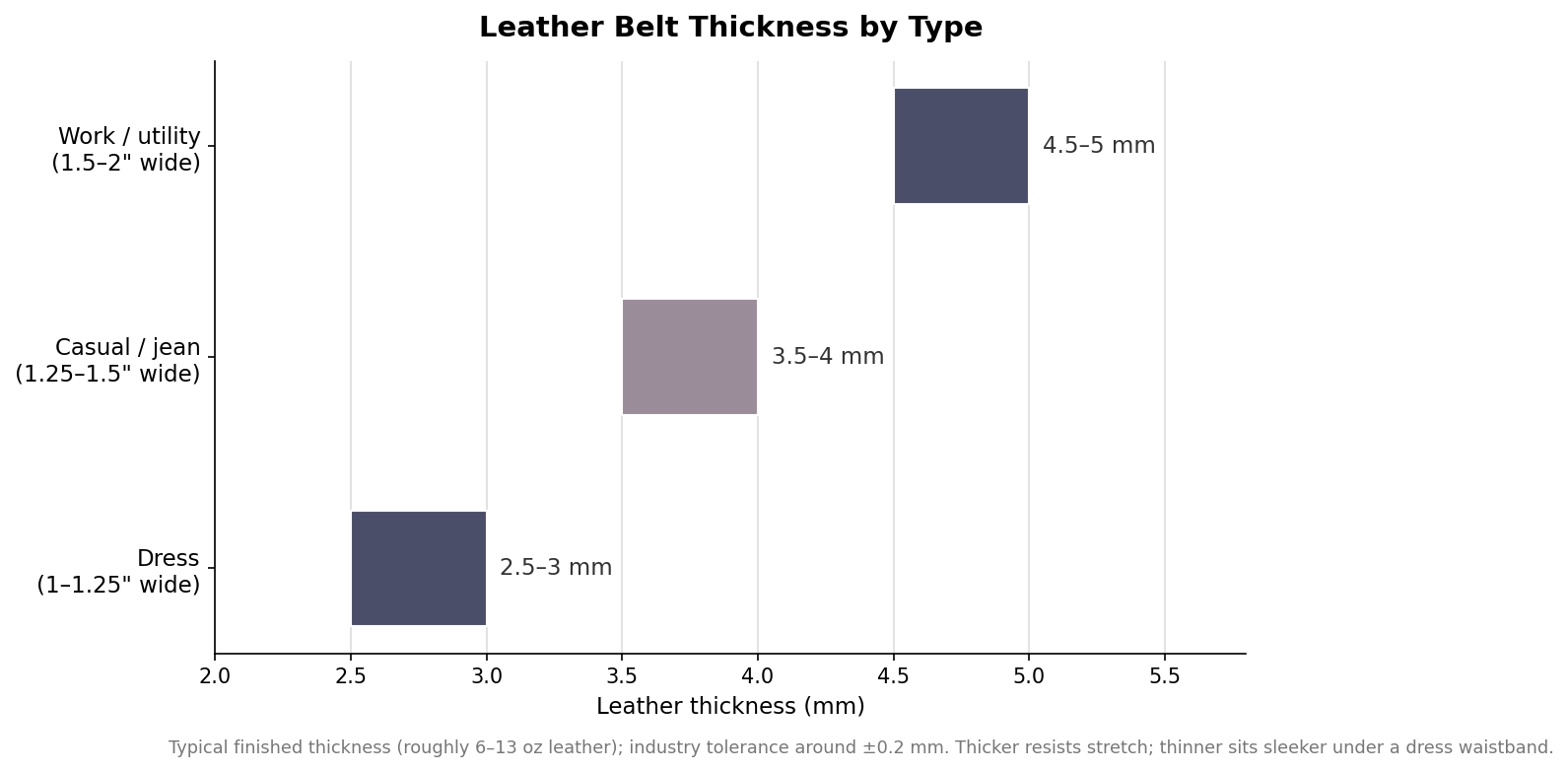
One useful construction note: a double-ply belt built from two thinner layers bonded together can reach the same finished thickness as a single thick strap while flexing more comfortably and resisting the curl that a solid heavy strip can develop. If you want substance without stiffness, that is worth asking about.
Buckle style shapes the look and the sizing
The single-prong pin buckle is the default for dress and most casual belts, simple and easy to size. A double-prong reads heavier and more fashion-forward. Plate or clamp buckles, common on Western and branded belts, attach with snaps so the strap and buckle can be swapped, which is handy when you want one strap to carry interchangeable branded plates. Ratchet or automatic buckles abandon holes entirely and grip a toothed track, giving micro-adjustment in very small increments and a clean hole-free strap, which is why they have become popular in golf and modern dress belts. For casual and promotional programs, a nylon webbing belt with a D-ring or box-frame buckle is inexpensive, endlessly color-matchable, and a natural canvas for a woven or printed logo.
Getting the size right
The reliable rule for pin-buckle belts is to order two inches above the pant waist size, so a 34-inch waist takes a 36 belt. That places the wearer near the middle hole with room on either side. The most accurate method, if a customer already owns a belt that fits, is to measure it from the buckle pin to the hole they actually use, and order that length. Standard belts carry five holes spaced an inch apart, which gives a four-inch total adjustment range, so being off by a size is not fatal but being off by two often is.
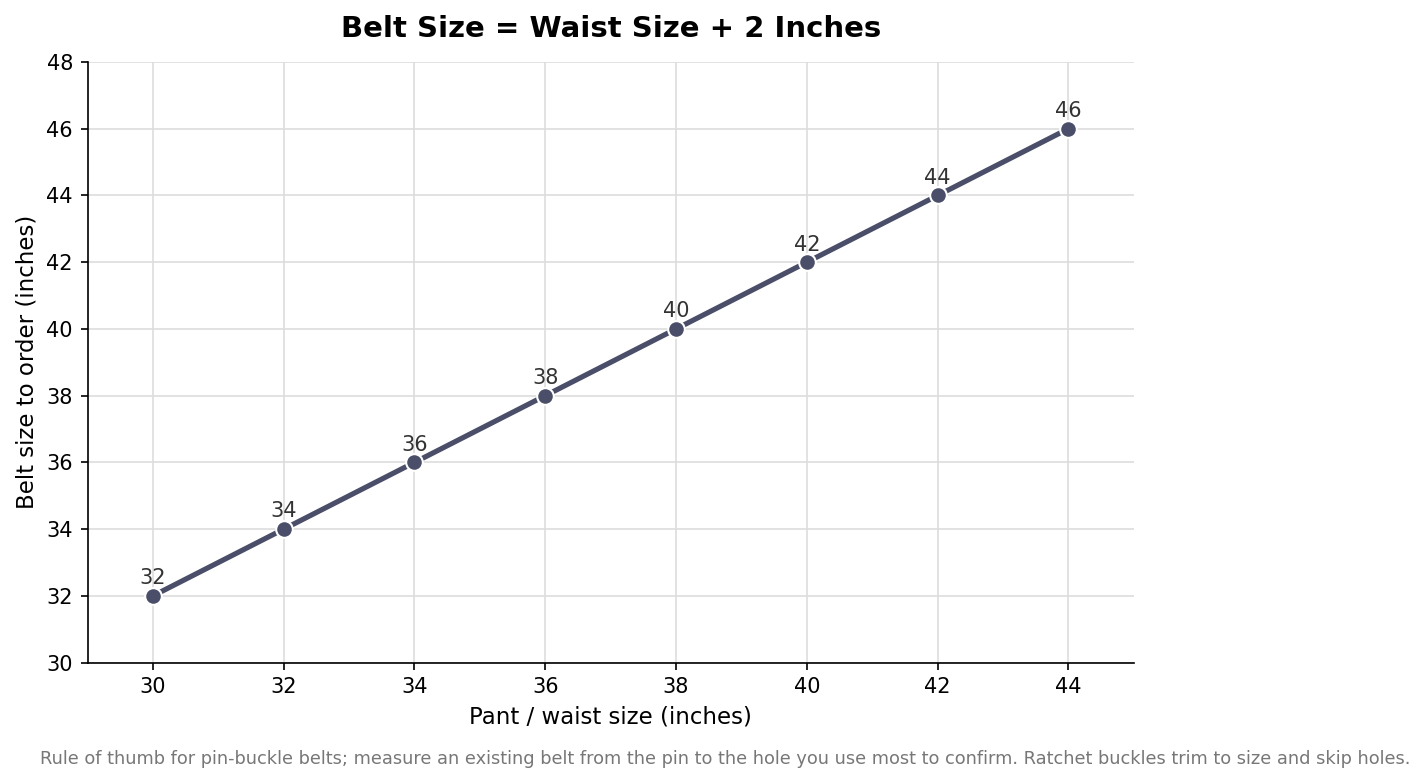
Ratchet and trim-to-fit belts change this math: they typically ship long and are cut down to the wearer, which makes them forgiving for gifting or resale where you do not know exact sizes in advance. If you are running a single bulk size for an unknown group, a trim-to-fit or webbing style removes most of the sizing risk.
Decoration and how to write the spec
On leather, the cleanest branding is usually blind embossing or debossing, which presses your mark into the surface without ink, or hot-foil stamping for a metallic finish; laser engraving is another crisp option. On webbing, a woven jacquard logo or a printed repeat runs the length of the strap. Custom buckle plates let the brand live on the metal instead of the leather. Whatever route you choose, bring the full specification to the quote: leather grade, thickness in millimeters, width in inches, buckle type, decoration method, and either the size run or a note that the belts are trim-to-fit. A brief that reads “full-grain, 3.5 mm, 1.5 inch, pin buckle, blind-embossed logo, sizes 32 to 42” produces an accurate price and a predictable belt. “Custom leather belts” invites a bonded-leather substitute that only reveals itself when the strap starts to crack.
Win Free Stuff
Enter below for a chance to win plus receive 10% off your first order.
🎉 You are in!
Check your email for your 10% off code. Good luck!