Search custom belts and almost everything you find is leather. That makes sense for dress and uniform programs, but it leaves out an entire category that is often the better answer for teams, events, kids, and anything that lives outdoors: the webbing belt. A webbing belt is a woven strap of synthetic or natural fiber finished with a buckle, and its appeal is that it can be printed in full color, cut to any length, and priced well below leather. The catch is that webbing is not one material. The fiber you choose decides how the belt wears, how it prints, and how long it survives a summer of sun and sweat, so it is worth understanding the choices before you brief a supplier.
Polyester: the default for a printed belt
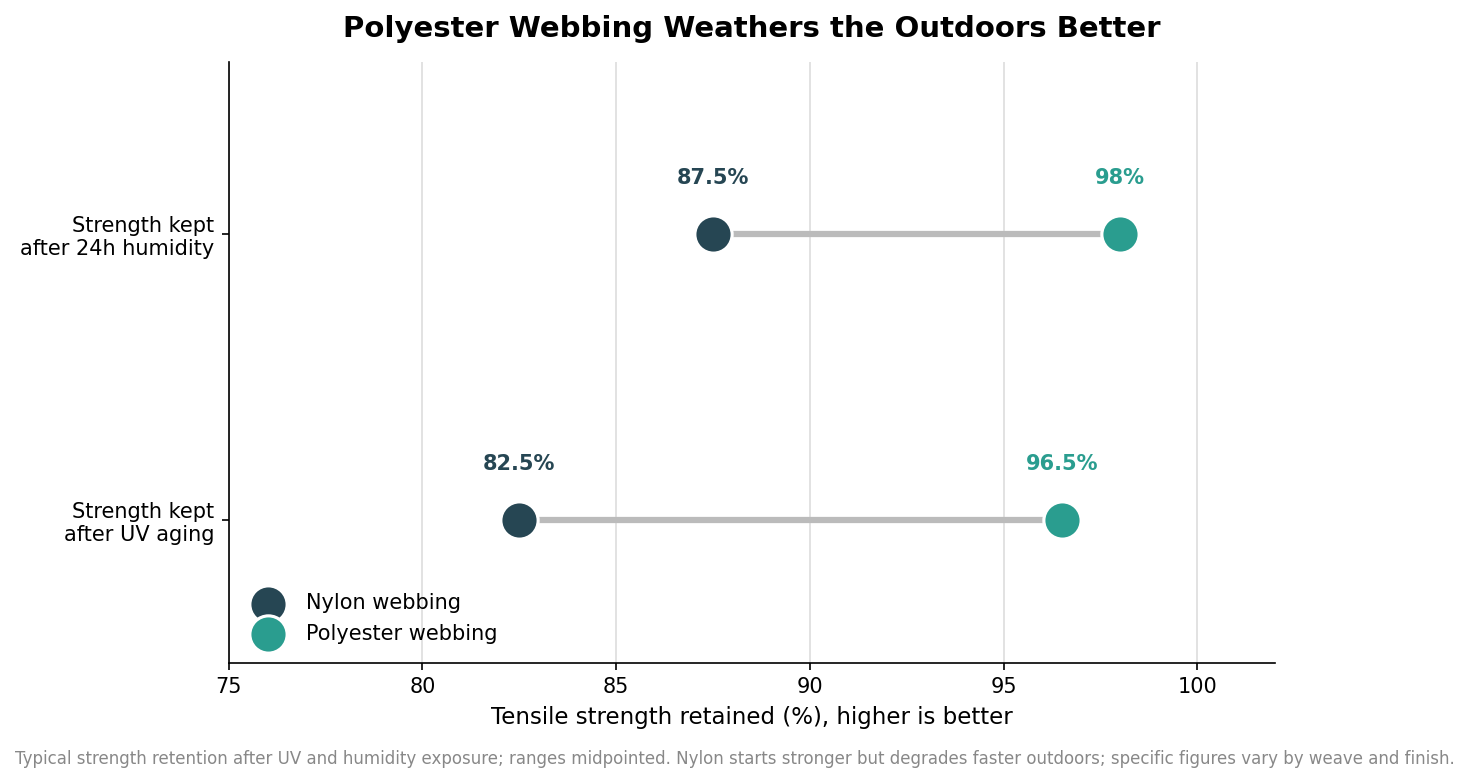
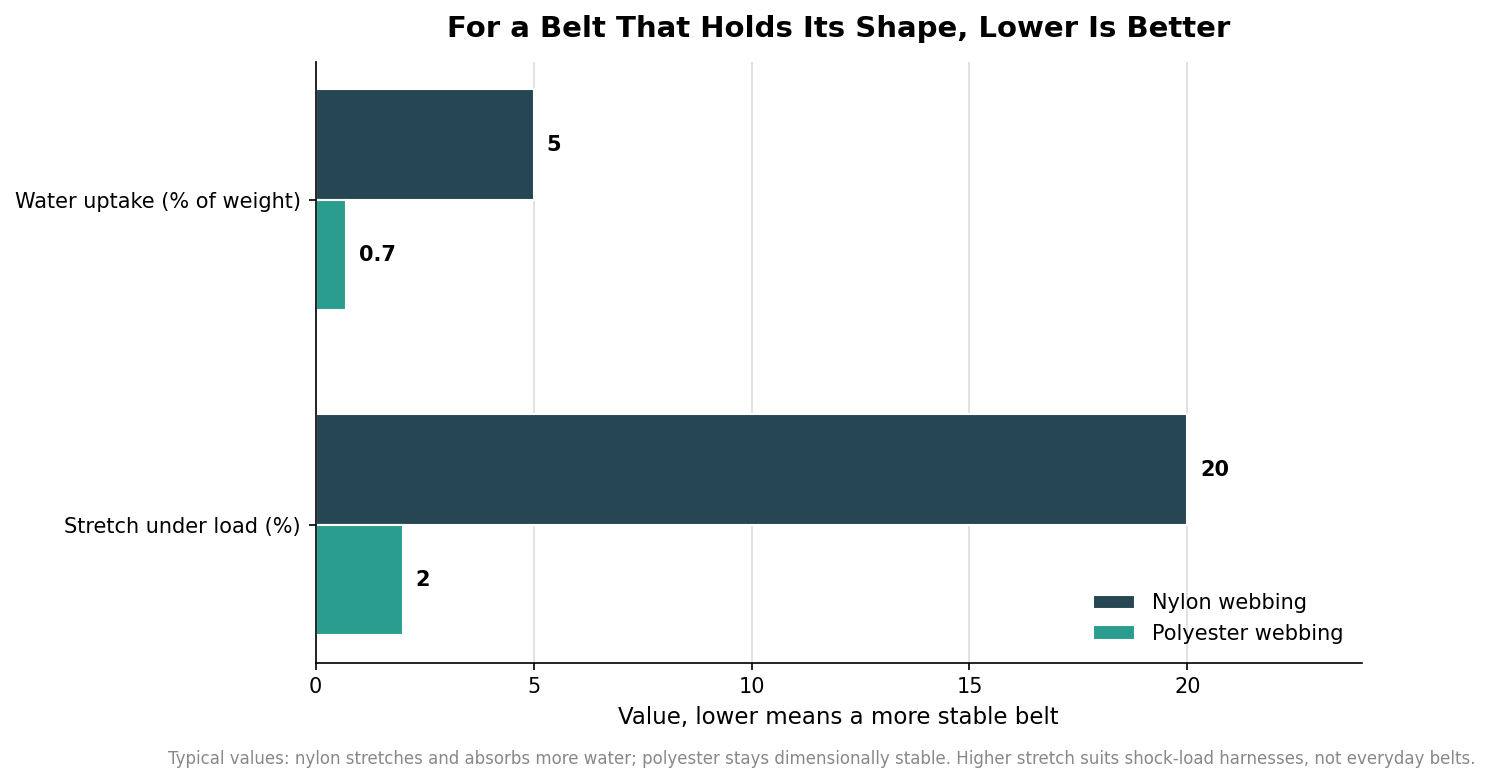
If your belt carries a logo, a pattern, or team colors, polyester webbing is almost always the right base. Two properties make it so. First, polyester is the ideal fiber for dye sublimation, the process that fuses full-color, edge-to-edge artwork into the strap with crisp, durable results rather than a printed layer that sits on top and eventually cracks. Second, it is remarkably stable outdoors. Polyester holds within about five percent of its strength after UV exposure and absorbs less than one percent of its weight in water, so a belt worn in the sun and rain keeps its color and shape. It stretches very little under load, which is exactly what you want from a belt: it should hold a waist, not give like a bungee. For everyday belts, promotional runs, and anything sublimated, polyester is the workhorse.
Nylon: stronger and stretchier, harder to print
Nylon is the strongest of the common webbings and the most elastic, stretching on the order of 15 to 25 percent under a shock load, which is why it dominates fall-arrest harnesses and heavy tactical gear where that give absorbs energy. Those same traits are a mixed bag for a belt. The strength is welcome, but the stretch means a nylon belt can feel less locked-in, and nylon does not take dye sublimation the way polyester does; it is colored with acid dyes instead, which is fine for solid shades but limits full-color printed graphics. Nylon also absorbs four to six percent of its weight in water and can shed 10 to 15 percent of its strength after a day in high humidity, and it degrades faster in sunlight, losing 15 to 20 percent of its strength with prolonged outdoor exposure. Choose nylon when raw strength and a rugged, tactical look matter more than photographic printing.
Polypropylene and cotton: the budget and the soft-feel options
Two other fibers round out the field. Polypropylene is the lightweight, low-cost choice; it does not absorb water at all, so it will not rot or mildew, which makes it popular for cheap, colorful straps and giveaways. The trade-off is that it is weaker than nylon or polyester, has only fair UV resistance, and is not suited to quality printing, so treat it as an economy option rather than a belt you expect to last years. Cotton webbing sits at the other end of the feel spectrum, offering a soft, casual, matte look that dyes easily with standard fabric dyes and suits fashion and lifestyle belts. It is the least strong and the poorest at shrugging off water and sun, so it is a style choice for indoor and light use rather than a performance material. For most branded programs the real decision is polyester versus nylon, with these two as situational picks.
Buckles and widths change the belt as much as the fiber
The buckle sets both the look and how the belt is used. A double D-ring is the simplest and most adjustable, threads through any waist without preset holes, and gives a clean casual or military look. A flip-top or clamp buckle grips the webbing at any point for a precise, no-holes fit and a more finished appearance, which is why it is common on printed fashion belts. An open-face roller buckle over a tri-glide reads as classic and utilitarian. Width matters too: a one-and-a-half inch, roughly 38 millimeter, strap is the standard adult belt width and pairs with most trouser loops, while a one-inch, 25 millimeter, strap suits slimmer styles and youth sizing. Match the buckle finish and the strap width to how the belt will be worn before you lock the design, because a buckle that looks great in a render can be wrong for the belt loops it has to pass through.
Getting the decoration and the order right
For printed webbing you have three main decoration routes. Sublimation on polyester gives unlimited color and can run edge to edge and even double-sided, and it is the method behind most vivid custom belts. Woven or jacquard construction builds a pattern or repeating logo into the weave itself for a textured, extremely durable result, at the cost of fine gradients and photographic detail. Screen printing applies spot colors on top and is economical for simple logos but wears sooner than sublimation. Whichever route you pick, confirm the fiber, the width, the buckle style and finish, and the decoration method together on a written quote, and ask for the minimum order quantity and the lead time rather than assuming, since these vary widely by supplier and by decoration type. Approve a physical or digital proof before the run, because on a belt the artwork, the length, and the buckle all have to be right at once, and the time to catch a mismatch is before the webbing is cut and stitched.
Win Free Stuff
Enter below for a chance to win plus receive 10% off your first order.
🎉 You are in!
Check your email for your 10% off code. Good luck!