When someone picks up a belt, the strap is what they judge on the shelf, but the buckle is what they interact with every single day. The closure decides how finely the belt fits, how it feels to fasten, how long the strap survives, and how much room you have to put a brand on it. Yet buckle choice is often an afterthought behind leather grade and color. This guide walks through the main closure systems for custom belts, what each one does well, and how the closure shapes both fit and branding so you can specify it deliberately.
The closure is the part your customer touches
Every belt is really a fastening system wrapped in a strap. The buckle governs three things at once: the range and precision of the fit, the durability of the strap where it takes stress, and the surface you have available for branding. A belt that fits in coarse jumps frustrates the wearer; a belt whose fastening stresses the leather wears out early; a belt with no flat hardware gives you nowhere clean to place a logo. Because those trade-offs pull in different directions, there is no single best closure, only the right one for the use case. The sections below cover the systems you will actually choose among for a custom program.
Prong and box-frame buckles: the traditional workhorses
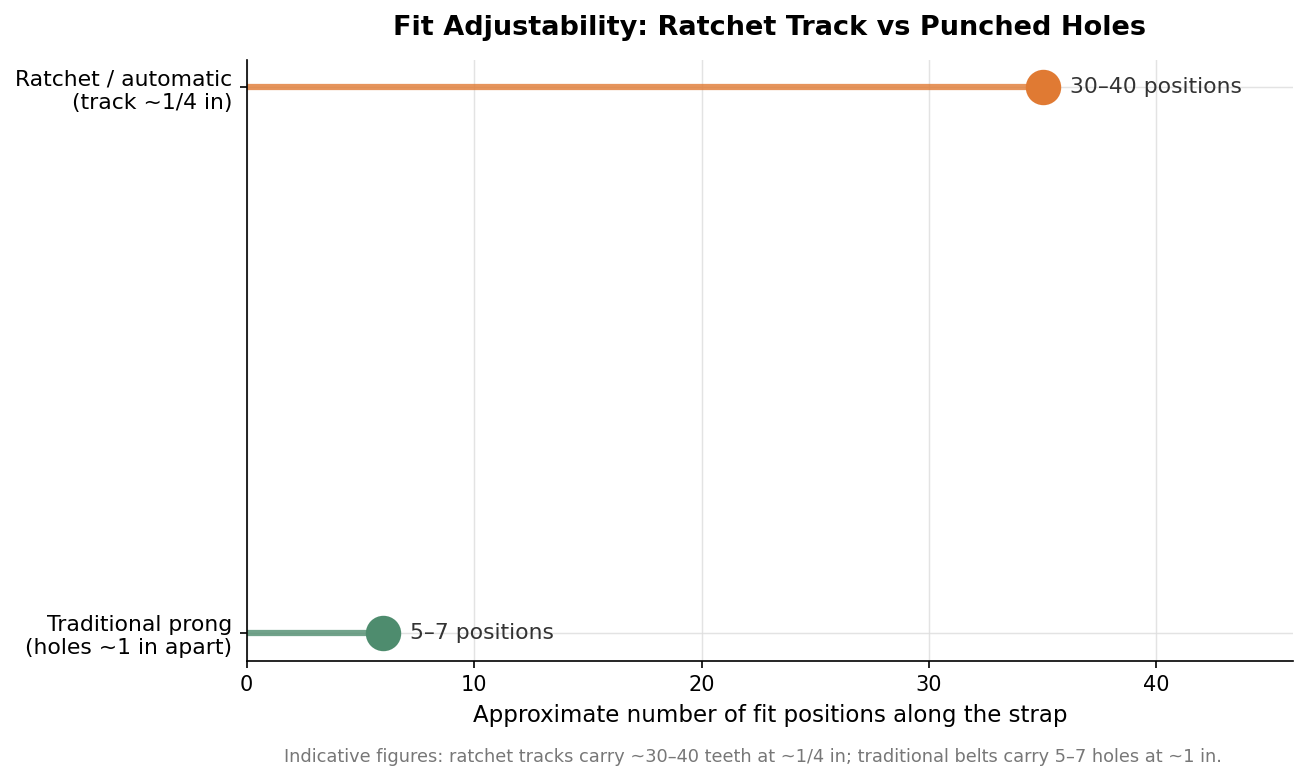
The pin-and-hole belt is simple, proven, and coarse by design. A frame buckle drives a metal prong through one of a row of holes punched about one inch apart, typically five to seven of them. The appeal is mechanical honesty: there is nothing to break beyond the pin itself, so failure-mode risk is essentially zero, and the look suits everything from dress to everyday wear. The limitation is fit granularity and wear. With holes an inch apart, the wearer is often stuck choosing between slightly loose and slightly tight, and the punched holes tend to stretch and elongate over time. A box-frame buckle, where the metal frame surrounds the end of the belt, is a close cousin that reads more western and rugged. Both are reliable defaults when the priority is a classic look and a bulletproof mechanism.
Ratchet and automatic buckles: micro-adjust fit
A track replaces the holes and multiplies the fit positions. Ratchet, or automatic, belts hide a toothed track on the underside of the strap, commonly thirty to forty small teeth spaced roughly a quarter inch apart, which yields thirty to forty usable fit positions instead of five to seven, around four times the precision of a hole belt. These belts are sized by trimming rather than by hole: you measure your waist where the belt sits, add roughly two to four inches, and cut the tip end to length. Because the track carries the load instead of a punched hole, it does not stress and elongate the leather the same way. The one caveat worth stating plainly is mechanism quality. Budget ratchet buckles built with plastic internal parts can fail within twelve to eighteen months, while a well-engineered metal mechanism will typically outlast the strap. For a custom program, ratchet buckles laser-etch cleanly and sell a genuine comfort story, which is why they have taken so much of the business-casual market.
D-ring, snap and plate: webbing, swap-ability, and branding
Some closures exist mainly to make the belt cheap to brand or easy to change. A D-ring or O-ring closure threads a fabric strap through two metal rings and holds by friction, which is why it dominates canvas and webbing belts; it is inexpensive, infinitely fine in adjustment, and pairs with a strap you can print or weave a logo across end to end. A slide or friction bar works similarly on webbing and suits casual, travel and tactical straps. At the other end sits the plate, or trophy, buckle: a flat metal plate attached to the strap by screws or snaps, which is both a western styling cue and the single largest branding canvas a belt offers, ideal for an engraved or enamel-filled logo. Snap-fastened straps take this further by letting one belt accept interchangeable buckles, so a customer can swap a dress plate for a casual one on the same strap. If branding real estate or buckle-swapping is the point, these are the systems to reach for.
Width, and why it constrains the buckle
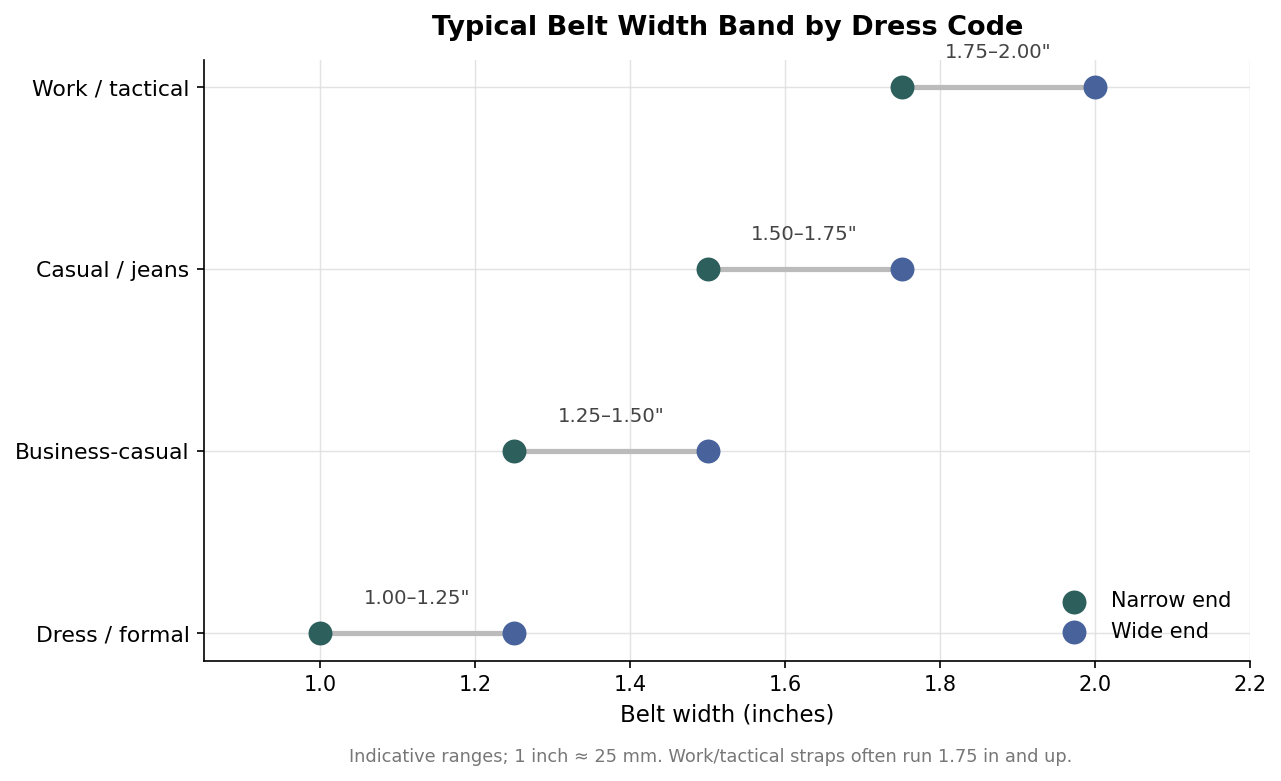
Width is not just a style choice; it dictates which hardware will physically fit. A buckle is built for a specific strap width, so a one-and-a-half-inch belt needs a one-and-a-half-inch buckle, and mixing them is not optional. Width also tracks closely with dress code. Dress and formal belts run about one to one and a quarter inches, roughly twenty-five to thirty-two millimeters, and favor slim frame buckles. Business-casual belts sit around one and a quarter to one and a half inches. Casual and jeans belts move up to one and a half to one and three-quarter inches with more rugged hardware, and work or tactical belts commonly start at one and three-quarter inches and go up, where the wider strap supports heavier loads. Deciding width early narrows your buckle options before you shop them, which is exactly the order you want to work in.
Specifying the closure for a custom program
Choose the closure from the use case and the branding goal, then match everything else to it. If the belt is a dress or uniform piece and reliability matters most, a prong or box-frame buckle on a one-to-one-and-a-half-inch strap is the safe, classic answer. If the selling point is comfort and modern fit, a metal ratchet mechanism earns its place, provided you specify metal internals rather than plastic. If the program lives or dies on brand visibility, a plate buckle or a printed webbing belt with a D-ring gives you the most logo surface, and a snap strap adds the flexibility of interchangeable buckles. Whatever you pick, confirm the buckle width matches the strap, decide how the buckle attaches, whether stitched, snapped, or screwed, and get a physical sample in hand before the bulk run, because the closure is the part your customer will touch, adjust and judge for the life of the belt.