Category: Uncategorized

  • Belt Buckle and Closure Types: A Guide to Choosing the Right Fastening

    Belt Buckle and Closure Types: A Guide to Choosing the Right Fastening

    When someone picks up a belt, the strap is what they judge on the shelf, but the buckle is what they interact with every single day. The closure decides how finely the belt fits, how it feels to fasten, how long the strap survives, and how much room you have to put a brand on it. Yet buckle choice is often an afterthought behind leather grade and color. This guide walks through the main closure systems for custom belts, what each one does well, and how the closure shapes both fit and branding so you can specify it deliberately.

    The closure is the part your customer touches

    Every belt is really a fastening system wrapped in a strap. The buckle governs three things at once: the range and precision of the fit, the durability of the strap where it takes stress, and the surface you have available for branding. A belt that fits in coarse jumps frustrates the wearer; a belt whose fastening stresses the leather wears out early; a belt with no flat hardware gives you nowhere clean to place a logo. Because those trade-offs pull in different directions, there is no single best closure, only the right one for the use case. The sections below cover the systems you will actually choose among for a custom program.

    Prong and box-frame buckles: the traditional workhorses

    The pin-and-hole belt is simple, proven, and coarse by design. A frame buckle drives a metal prong through one of a row of holes punched about one inch apart, typically five to seven of them. The appeal is mechanical honesty: there is nothing to break beyond the pin itself, so failure-mode risk is essentially zero, and the look suits everything from dress to everyday wear. The limitation is fit granularity and wear. With holes an inch apart, the wearer is often stuck choosing between slightly loose and slightly tight, and the punched holes tend to stretch and elongate over time. A box-frame buckle, where the metal frame surrounds the end of the belt, is a close cousin that reads more western and rugged. Both are reliable defaults when the priority is a classic look and a bulletproof mechanism.

    Ratchet and automatic buckles: micro-adjust fit

    A track replaces the holes and multiplies the fit positions. Ratchet, or automatic, belts hide a toothed track on the underside of the strap, commonly thirty to forty small teeth spaced roughly a quarter inch apart, which yields thirty to forty usable fit positions instead of five to seven, around four times the precision of a hole belt. These belts are sized by trimming rather than by hole: you measure your waist where the belt sits, add roughly two to four inches, and cut the tip end to length. Because the track carries the load instead of a punched hole, it does not stress and elongate the leather the same way. The one caveat worth stating plainly is mechanism quality. Budget ratchet buckles built with plastic internal parts can fail within twelve to eighteen months, while a well-engineered metal mechanism will typically outlast the strap. For a custom program, ratchet buckles laser-etch cleanly and sell a genuine comfort story, which is why they have taken so much of the business-casual market.
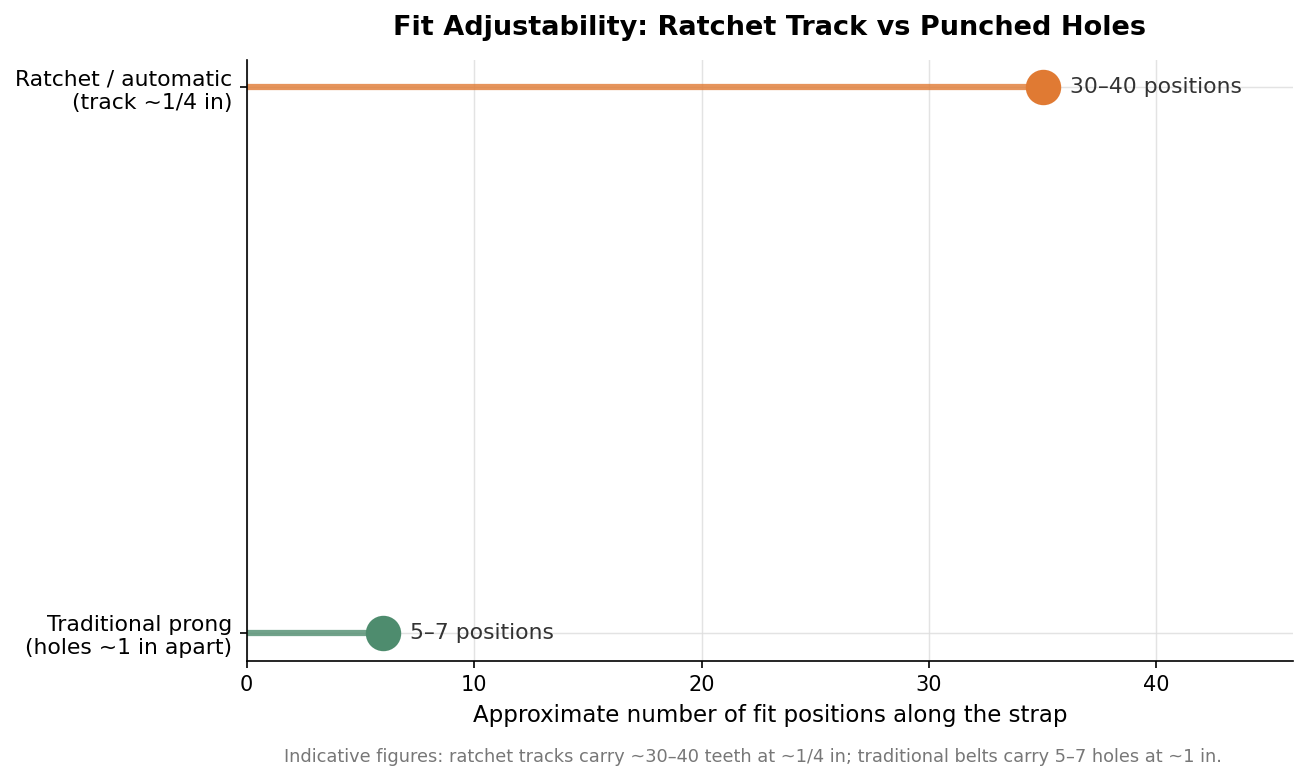
    Lollipop chart comparing fit positions: about 5 to 7 for a traditional prong belt with holes one inch apart versus 30 to 40 for a ratchet belt with a quarter-inch track
    A ratchet track offers roughly four times the fit positions of a punched-hole belt.

    D-ring, snap and plate: webbing, swap-ability, and branding

    Some closures exist mainly to make the belt cheap to brand or easy to change. A D-ring or O-ring closure threads a fabric strap through two metal rings and holds by friction, which is why it dominates canvas and webbing belts; it is inexpensive, infinitely fine in adjustment, and pairs with a strap you can print or weave a logo across end to end. A slide or friction bar works similarly on webbing and suits casual, travel and tactical straps. At the other end sits the plate, or trophy, buckle: a flat metal plate attached to the strap by screws or snaps, which is both a western styling cue and the single largest branding canvas a belt offers, ideal for an engraved or enamel-filled logo. Snap-fastened straps take this further by letting one belt accept interchangeable buckles, so a customer can swap a dress plate for a casual one on the same strap. If branding real estate or buckle-swapping is the point, these are the systems to reach for.

    Width, and why it constrains the buckle

    Width is not just a style choice; it dictates which hardware will physically fit. A buckle is built for a specific strap width, so a one-and-a-half-inch belt needs a one-and-a-half-inch buckle, and mixing them is not optional. Width also tracks closely with dress code. Dress and formal belts run about one to one and a quarter inches, roughly twenty-five to thirty-two millimeters, and favor slim frame buckles. Business-casual belts sit around one and a quarter to one and a half inches. Casual and jeans belts move up to one and a half to one and three-quarter inches with more rugged hardware, and work or tactical belts commonly start at one and three-quarter inches and go up, where the wider strap supports heavier loads. Deciding width early narrows your buckle options before you shop them, which is exactly the order you want to work in.
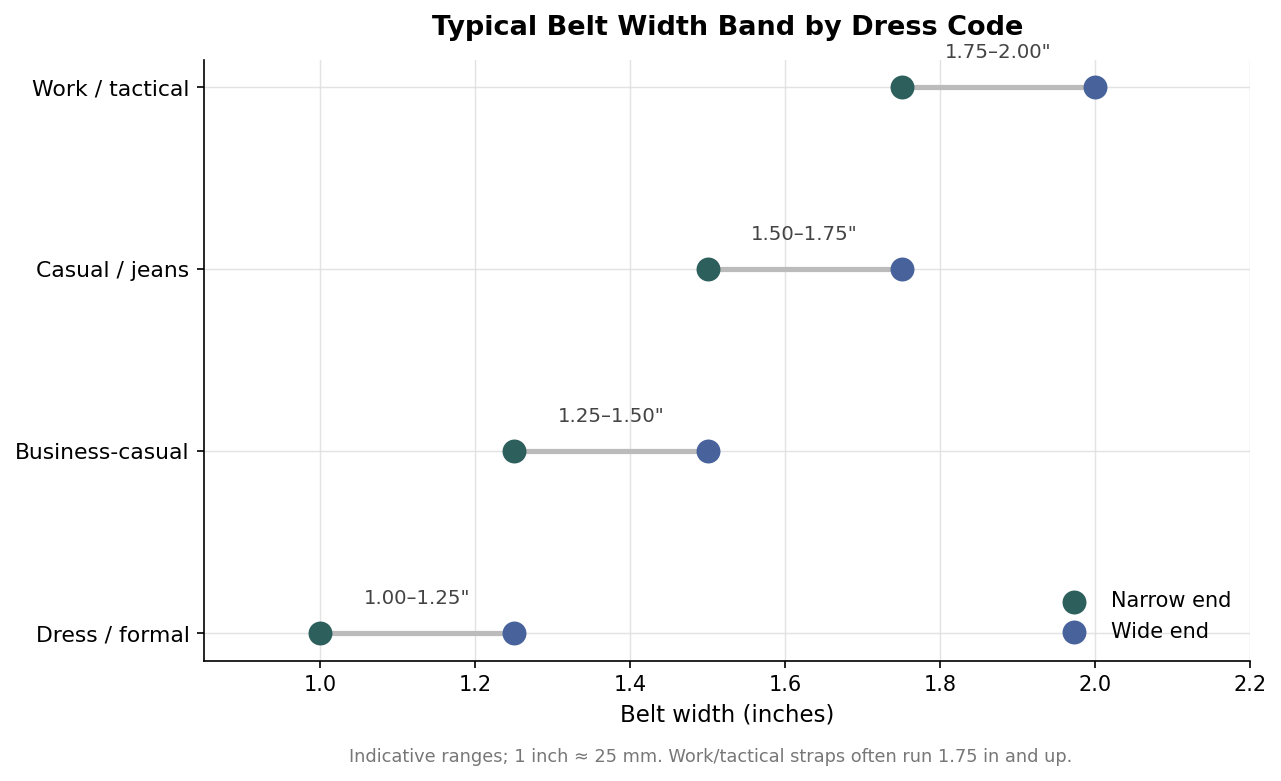
    Dot plot of typical belt width bands in inches by dress code, from 1.0 to 1.25 for dress belts up to 1.75 to 2.0 inches for work and tactical belts
    Typical belt width bands by dress code; the buckle must match the strap width.

    Specifying the closure for a custom program

    Choose the closure from the use case and the branding goal, then match everything else to it. If the belt is a dress or uniform piece and reliability matters most, a prong or box-frame buckle on a one-to-one-and-a-half-inch strap is the safe, classic answer. If the selling point is comfort and modern fit, a metal ratchet mechanism earns its place, provided you specify metal internals rather than plastic. If the program lives or dies on brand visibility, a plate buckle or a printed webbing belt with a D-ring gives you the most logo surface, and a snap strap adds the flexibility of interchangeable buckles. Whatever you pick, confirm the buckle width matches the strap, decide how the buckle attaches, whether stitched, snapped, or screwed, and get a physical sample in hand before the bulk run, because the closure is the part your customer will touch, adjust and judge for the life of the belt.
  • What Size Custom Belt Should You Order? A Sizing Guide That Prevents Returns

    What Size Custom Belt Should You Order? A Sizing Guide That Prevents Returns

    A custom belt is cut, punched, and stamped to the length you specify, which makes ordering the wrong size the most expensive mistake in the whole process. Unlike a belt pulled off a peg, a made-to-order strap usually cannot be swapped for the next size up, and trimming one down after the fact moves every hole, and often the maker’s mark, along with it. Spending a careful few minutes on the number before you order is worth far more than the guesswork it replaces.

    The confusion almost always starts with the number itself. A belt size and a pant size describe two different measurements, and treating them as the same figure is where most orders go sideways. A belt size refers to the length of the strap at its usable middle hole, measured in inches. A pant size refers to a waistband circumference that, thanks to years of vanity sizing, is frequently an inch or two smaller than your actual waist. Order a belt to match the tag on your jeans and you will often end up fastening on the very first hole, or running out of holes entirely.

    Start With Your Pant Size, Then Add Two Inches

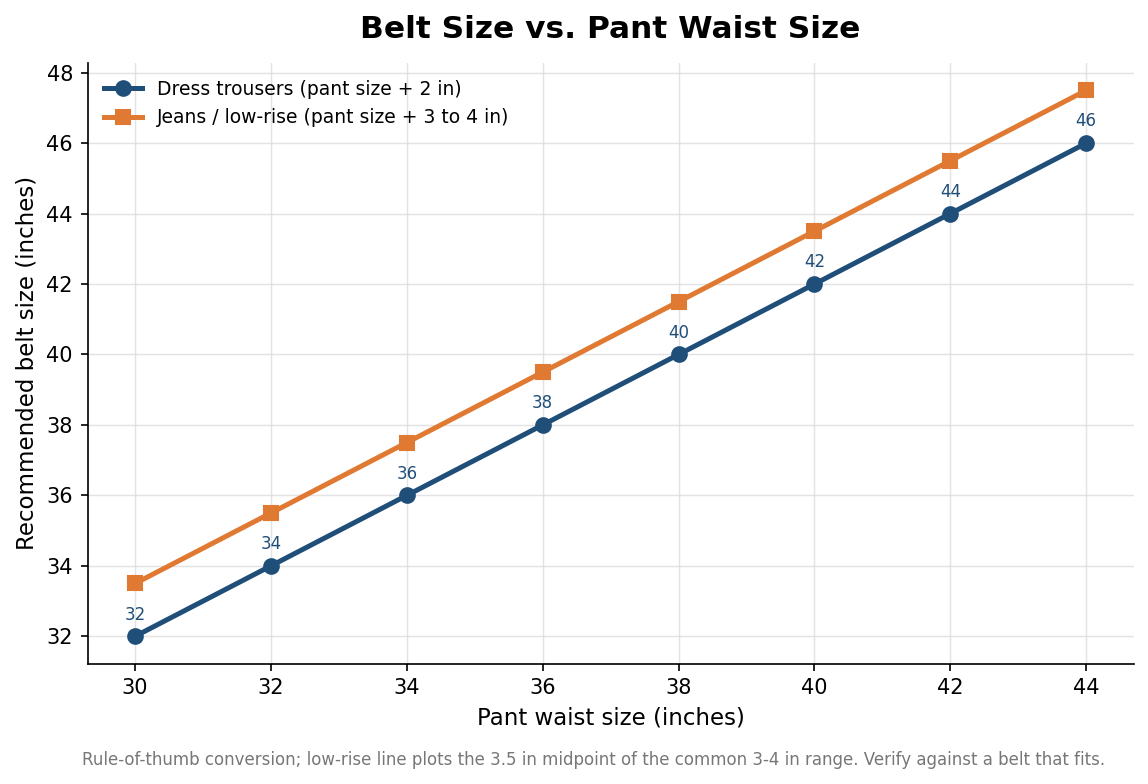
    The fastest estimate is also the oldest one: take your true off-the-rack trouser size and add two inches. A 36-inch dress trouser generally pairs with a 38 belt, a 34 with a 36, and so on up the range. The two inches account for the belt wrapping the outside of the waistband, passing through the loops, and reaching a comfortable middle hole rather than straining on the last one.

    The rule shifts for lower-rise garments. Jeans and casual pants sit further down the hips, where the circumference is larger, so most makers suggest adding three to four inches instead of two. If you buy across both dress and casual styles, size for whichever you wear most, since a single belt cannot sit perfectly at two different rise heights. The chart below shows how the two conversions diverge as waist size climbs.

    Line chart comparing belt size to pant waist size for dress trousers versus jeans and low-rise pants
    Belt size climbs with waist size, and low-rise pants need an extra inch or two over dress trousers.

    Treat these numbers as a starting point, not a guarantee. Pant sizing is inconsistent from brand to brand, and a tag that reads 34 might measure anywhere from 33 to 36 in the real world. The conversion gets you into the right neighborhood; the next method gets you to the right house.

    The More Reliable Method: Measure a Belt You Already Wear

    If you own a belt that fits the way you like, it will tell you your size more honestly than any pant tag. Lay the belt flat on a table without stretching it, then run a tape measure from the hole you actually fasten to the fold where the leather meets the buckle, not the far tip of the buckle itself. Round that figure to the nearest inch and you have your belt size. Because it captures how you genuinely wear the belt, over which layers and at which hole, this method quietly corrects for stretch, posture, and the fact that most people cinch tighter or looser than a chart assumes.

    If you would rather measure your body, thread a cloth tape through your trouser loops while standing relaxed, keep it snug but not tight, and round up to the nearest inch. Standing measurements taken while holding your breath or sucking in will read short and leave you on the tightest hole, so measure the way you actually stand through a normal day.

    Why One Belt Covers a Range of Waists

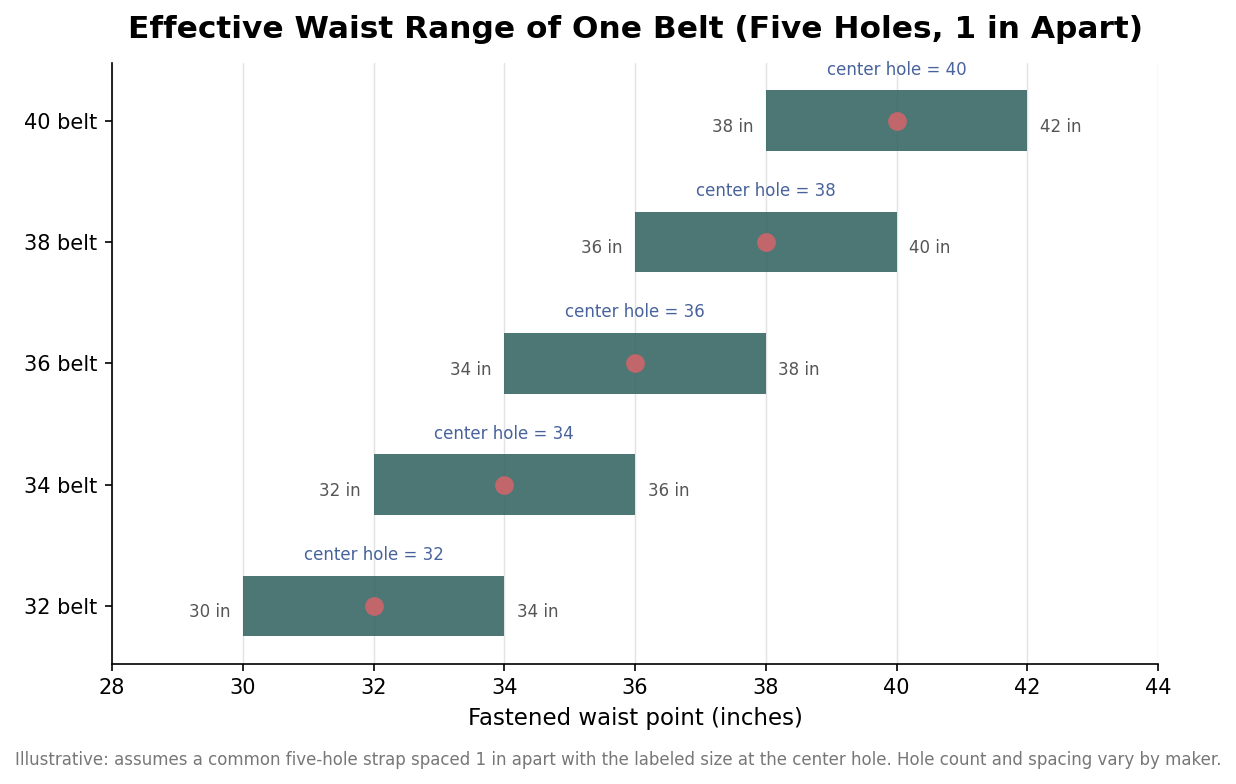
    A belt is not a single fixed length, and understanding its adjustment range takes the pressure off landing on an exact number. Most dress and casual belts are punched with five holes spaced one inch apart, and the labeled size is measured to the center hole. That layout means a belt sold as a 36 will fasten comfortably anywhere from roughly 34 to 38 inches, two holes tighter and two holes looser than its name suggests.

    The practical takeaway is to aim for the center hole rather than an end. Sizing so your everyday fit lands in the middle leaves room to tighten after a big meal or loosen as the leather relaxes, and it keeps the buckle centered and the tail a sensible length. If your measurement falls exactly between two sizes, choosing the larger one usually beats the smaller, since a belt worn on its first hole looks and wears better than one straining on its last.

    Horizontal range chart showing the roughly four-inch waist range each labeled belt size covers across five holes
    A single belt spans about four inches of waist across its five holes, with the labeled size at the center.

    Hole count and spacing are not universal, so confirm them before you order. Some western and heavy-duty straps use seven holes, and a few makers space holes three-quarters of an inch apart rather than a full inch, which narrows the range each size covers.

    Account for Stretch, Layering, and Buckle Style

    Leather relaxes with wear, and the amount depends on the construction. A single-layer bridle strap stretches modestly over its first months, while braided and woven belts give considerably more, which is why a fit that feels snug on day one often settles into the ideal hole later. Buyers who like a belt tight from the start can size to the center hole and let time do the rest; those who want it perfect immediately might size a touch generous.

    What you wear the belt over matters just as much. A tucked dress shirt, a heavier pair of winter jeans, or a work layer all add fabric between the belt and your waist, effectively shrinking the belt by a fraction. If the belt is bound for a uniform or a specific outfit, measure over those exact clothes. Buckle style plays a smaller but real role: a wide trophy or plate buckle consumes more of the strap’s length than a slim frame buckle, so a maker’s stated size always refers to the leather, from the fold to the working hole, and never includes the hardware.

    What to Confirm on the Order

    Because a custom strap is made to your specification, a short list of confirmations prevents nearly every sizing surprise. State plainly how you arrived at your number, whether it came from a belt you measured or a body measurement, so the maker can sanity-check it against their own method. Ask exactly how they define length, since some shops measure end-of-leather to center hole while others measure to the first hole, and a one-hole difference in that definition is a one-inch difference on your waist. Confirm the hole count and spacing so you know the real adjustment range you are buying, and specify the strap width and buckle type, since both affect how the finished belt reads and fits.

    Finally, ask what happens at the edges of the range. Many makers place a confirmation call on unusually short or long orders, often below the low thirties or above the high forties, precisely because those sizes fall outside the assumptions baked into a standard chart. A two-minute conversation there is the cheapest insurance you will buy on the whole order, and it is the difference between a belt that fits the day it arrives and one that becomes an expensive lesson in measuring twice.

  • Custom Webbing Belts: How to Choose the Fiber, Buckle, and Print

    Custom Webbing Belts: How to Choose the Fiber, Buckle, and Print

    Search custom belts and almost everything you find is leather. That makes sense for dress and uniform programs, but it leaves out an entire category that is often the better answer for teams, events, kids, and anything that lives outdoors: the webbing belt. A webbing belt is a woven strap of synthetic or natural fiber finished with a buckle, and its appeal is that it can be printed in full color, cut to any length, and priced well below leather. The catch is that webbing is not one material. The fiber you choose decides how the belt wears, how it prints, and how long it survives a summer of sun and sweat, so it is worth understanding the choices before you brief a supplier.

    Polyester: the default for a printed belt

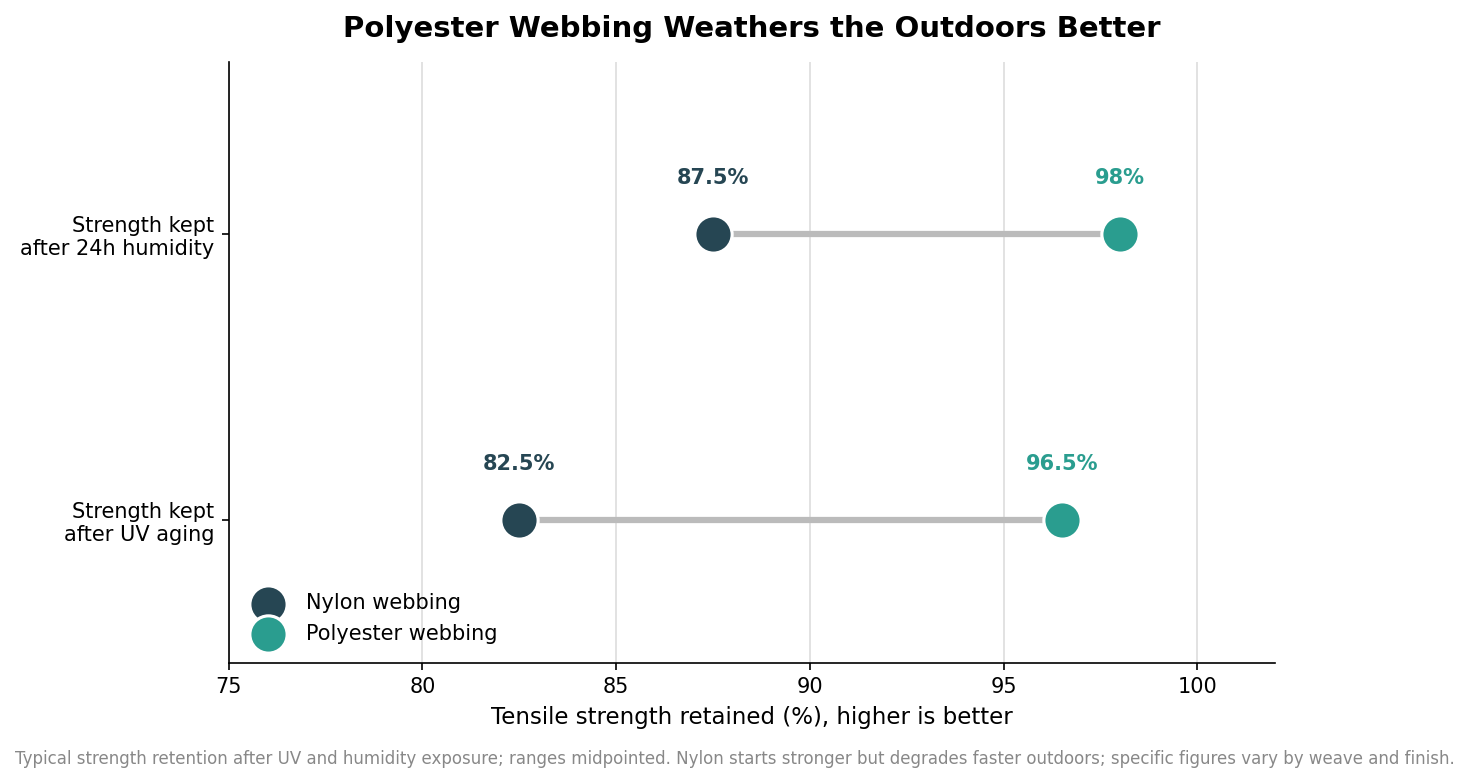
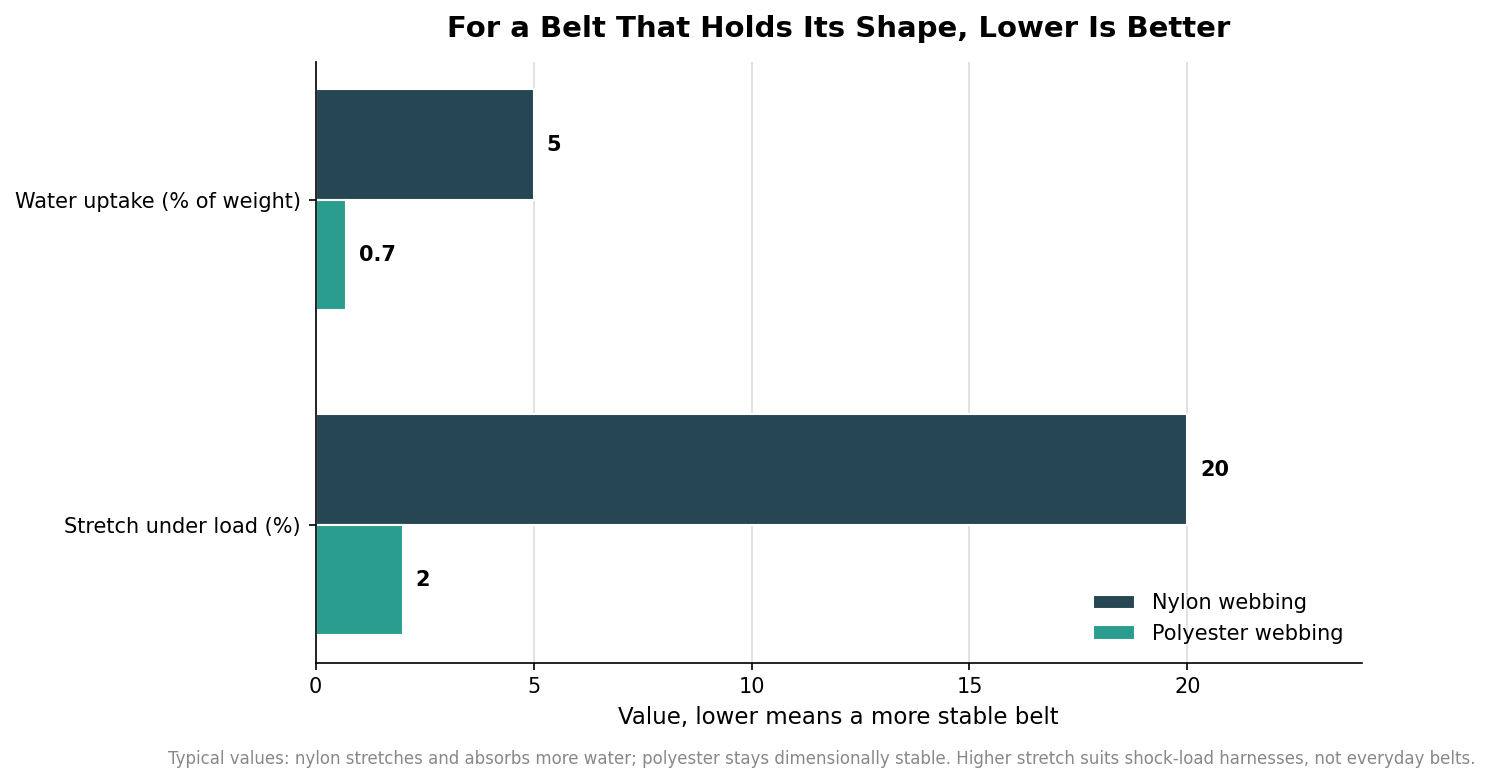
    If your belt carries a logo, a pattern, or team colors, polyester webbing is almost always the right base. Two properties make it so. First, polyester is the ideal fiber for dye sublimation, the process that fuses full-color, edge-to-edge artwork into the strap with crisp, durable results rather than a printed layer that sits on top and eventually cracks. Second, it is remarkably stable outdoors. Polyester holds within about five percent of its strength after UV exposure and absorbs less than one percent of its weight in water, so a belt worn in the sun and rain keeps its color and shape. It stretches very little under load, which is exactly what you want from a belt: it should hold a waist, not give like a bungee. For everyday belts, promotional runs, and anything sublimated, polyester is the workhorse.

    Dumbbell dot plot comparing tensile strength retained by nylon and polyester webbing after UV aging and humidity exposure, with polyester retaining more
    Polyester keeps more of its strength than nylon after sun and humidity, holding within a few percent.

    Nylon: stronger and stretchier, harder to print

    Nylon is the strongest of the common webbings and the most elastic, stretching on the order of 15 to 25 percent under a shock load, which is why it dominates fall-arrest harnesses and heavy tactical gear where that give absorbs energy. Those same traits are a mixed bag for a belt. The strength is welcome, but the stretch means a nylon belt can feel less locked-in, and nylon does not take dye sublimation the way polyester does; it is colored with acid dyes instead, which is fine for solid shades but limits full-color printed graphics. Nylon also absorbs four to six percent of its weight in water and can shed 10 to 15 percent of its strength after a day in high humidity, and it degrades faster in sunlight, losing 15 to 20 percent of its strength with prolonged outdoor exposure. Choose nylon when raw strength and a rugged, tactical look matter more than photographic printing.

    Horizontal grouped bar chart showing nylon webbing stretches and absorbs more water than polyester webbing
    For a belt that keeps its shape, polyester’s low stretch and near-zero water uptake win out.

    Polypropylene and cotton: the budget and the soft-feel options

    Two other fibers round out the field. Polypropylene is the lightweight, low-cost choice; it does not absorb water at all, so it will not rot or mildew, which makes it popular for cheap, colorful straps and giveaways. The trade-off is that it is weaker than nylon or polyester, has only fair UV resistance, and is not suited to quality printing, so treat it as an economy option rather than a belt you expect to last years. Cotton webbing sits at the other end of the feel spectrum, offering a soft, casual, matte look that dyes easily with standard fabric dyes and suits fashion and lifestyle belts. It is the least strong and the poorest at shrugging off water and sun, so it is a style choice for indoor and light use rather than a performance material. For most branded programs the real decision is polyester versus nylon, with these two as situational picks.

    Buckles and widths change the belt as much as the fiber

    The buckle sets both the look and how the belt is used. A double D-ring is the simplest and most adjustable, threads through any waist without preset holes, and gives a clean casual or military look. A flip-top or clamp buckle grips the webbing at any point for a precise, no-holes fit and a more finished appearance, which is why it is common on printed fashion belts. An open-face roller buckle over a tri-glide reads as classic and utilitarian. Width matters too: a one-and-a-half inch, roughly 38 millimeter, strap is the standard adult belt width and pairs with most trouser loops, while a one-inch, 25 millimeter, strap suits slimmer styles and youth sizing. Match the buckle finish and the strap width to how the belt will be worn before you lock the design, because a buckle that looks great in a render can be wrong for the belt loops it has to pass through.

    Getting the decoration and the order right

    For printed webbing you have three main decoration routes. Sublimation on polyester gives unlimited color and can run edge to edge and even double-sided, and it is the method behind most vivid custom belts. Woven or jacquard construction builds a pattern or repeating logo into the weave itself for a textured, extremely durable result, at the cost of fine gradients and photographic detail. Screen printing applies spot colors on top and is economical for simple logos but wears sooner than sublimation. Whichever route you pick, confirm the fiber, the width, the buckle style and finish, and the decoration method together on a written quote, and ask for the minimum order quantity and the lead time rather than assuming, since these vary widely by supplier and by decoration type. Approve a physical or digital proof before the run, because on a belt the artwork, the length, and the buckle all have to be right at once, and the time to catch a mismatch is before the webbing is cut and stitched.

  • Why Belts Are the Most Overlooked Piece of a Uniform Program

    Call or Text us: (929) 605-4397
    Business

    Why Belts Are the Most Overlooked Piece of a Uniform Program

    The gap nobody specifies

    Most uniform programs specify the shirt in detail and leave the belt to whoever is wearing it. That is a visible inconsistency in the one item nobody thinks to check.

    Mismatched belts undo a matched uniform

    A team in identical branded shirts and eight different belts does not read as uniformed. It reads as almost uniformed, which is worse than not trying, because the eye goes straight to the thing that does not match.

    It is the cheapest line in the kit to fix

    Belts are one of the least expensive items in a uniform program and among the longest lived. A full-grain belt outlasts several shirts, so the cost per year of service is lower than almost anything else you issue.

    Reorders are where programs fail

    New staff joining in year two need belts that match the originals. Because we cut a brass embossing die for your artwork and keep it on file, a reorder is identical to the first run rather than approximately similar. That is the whole reason to specify a belt centrally instead of leaving it to individuals.

    Sizing does not have to be a problem

    Supply a size run, or order untrimmed straps that are cut to fit on arrival. Send your sizes and artwork and we will quote the exact specification. Minimum order is 12 belts, production runs 2 weeks, and your free mockup arrives within 24 hours.

    Create your custom belts now.

    Send your logo, quantity and date — you’ll get a free mockup and quote within one business day.

    Get a Quote
    GET A QUOTE
  • Full-Grain vs Genuine Leather: What the Labels Actually Mean

    Call or Text us: (929) 605-4397
    Specs

    Full-Grain vs Genuine Leather: What the Labels Actually Mean

    The labels are not ranked the way they sound

    The leather grading language is close to deliberately misleading. Here is what each term really describes, and the one test that tells you which you are holding.

    Full-grain is the top of the range

    Full-grain is the outermost layer of the hide with the surface left intact, including its natural marks. It is the strongest part of the skin, it develops a patina rather than wearing out, and it is what a belt should be made of if it is going to be worn daily for years.

    Top-grain is a sanded compromise

    Top-grain is the same layer with the surface sanded off and a finish sprayed on to even it out. It looks more uniform and costs less, but removing the outer layer removes much of the strength, and the applied finish is what eventually cracks.

    Genuine leather is near the bottom

    Despite the name, this is a low grade: leftover scraps ground up, bonded with adhesive and embossed with a fake grain pattern. It fails at the fold, and once it starts it goes quickly. If a belt is unusually cheap, this is almost always why.

    The edge tells you the truth

    Look at the cut edge. Full-grain shows a dense, fibrous cross-section in one continuous piece. Bonded leather shows a uniform pressed layer, often with a visible backing. Thirty seconds and no equipment needed.

    What we would specify

    Full-grain with a stitched edge for anything worn daily or given as a gift. Minimum order is 12 belts, production runs 2 weeks, and the mockup is free within 24 hours.

    Create your custom belts now.

    Send your logo, quantity and date — you’ll get a free mockup and quote within one business day.

    Get a Quote
    GET A QUOTE
  • Custom Belts: A Buyer’s Guide

    Call or Text us: (929) 605-4397
    Buyer’s guide

    Custom Belts: A Buyer’s Guide

    The grade of leather decides everything

    A belt is worn more often than almost anything else you could put a logo on. It is also the product where the difference between grades is largest and least visible at the point of sale.

    โ€œGenuine leatherโ€ sounds like a guarantee and is in fact one of the lowest grades: ground-up scraps bonded back together. It cracks at the fold, usually within a year. Full-grain keeps the intact surface of the hide and gets better with wear. Two belts can look identical on day one and be in completely different condition by month twelve.

    Decide whether the strap or the buckle carries the brand

    Debossing on the strap is understated and reads as corporate. A cast metal buckle is the opposite: three-dimensional, visible from across a room, and kept long after the strap is worn out. Neither is better, but choosing one deliberately is what separates a considered product from a generic one.

    Match the construction to the job

    A dress belt holds up trousers. A tactical belt carries a holster and a radio, which needs stiffened webbing and load-rated hardware or it rolls over under weight. A woven belt breathes in heat where leather does not. These are genuinely different products and substituting one for another is the most common specification error we see.

    Get sizing right before you order

    For a uniform program, supply a size run rather than one length. We can also supply belts untrimmed so they are cut to fit on arrival, which removes the sizing problem entirely for gifts and awards.

    What to expect when you order

    Send your sizes and whatever artwork you have. You will get a free mockup within 24 hours, unlimited free revisions, and you pay nothing until you approve it. Minimum order is 12 belts and production runs 2 weeks, with faster turnaround available on express shipping.

    Create your custom belts now.

    Send your logo, quantity and date — you’ll get a free mockup and quote within one business day.

    Get a Quote
    GET A QUOTE
  • Custom Leather Belts: Grade, Thickness, Buckle, and Sizing Explained

    Custom Leather Belts: Grade, Thickness, Buckle, and Sizing Explained

    A custom belt is one of the few accessories a customer wears every day, and it is also one of the easiest to get wrong at the ordering stage, because “leather belt” covers everything from a cracking bonded-scrap strap to a full-grain piece that outlives the jeans it holds up. The four things that determine which one you receive are the leather grade, the thickness and width, the buckle, and the size. This is a spec comparison built around those four decisions, so you can specify a belt that matches its job instead of hoping the sample lives up to the photo.

    Leather grade decides how long it lasts

    Full-grain leather is the top tier. It uses the entire grain layer with its fiber structure intact, which gives natural strength, a surface that develops a patina, and the longest service life. Because the fibers are dense, full-grain performs best at a moderate thickness of roughly 2.5 to 3.5 millimeters rather than needing to be bulked up. Top-grain has the very outer surface sanded and refined, trading a little longevity for a more uniform, blemish-free look, and it works well in the 3.0 to 4.0 millimeter range.

    Below those sit genuine, split, and bonded leather. Split or corrected-grain comes from lower layers of the hide and should be kept under about 3.5 millimeters, because pushed thicker it turns stiff and is prone to cracking. Bonded leather, made from ground leather scrap bound with adhesive, is the cheapest input and the shortest-lived; it can be fine for a low-cost promotional run that is not expected to last years, but it is the wrong choice for anything sold as a quality product. Naming the exact grade in your spec is the single biggest lever on both cost and how the belt ages.

    Thickness and width: match the belt to the job

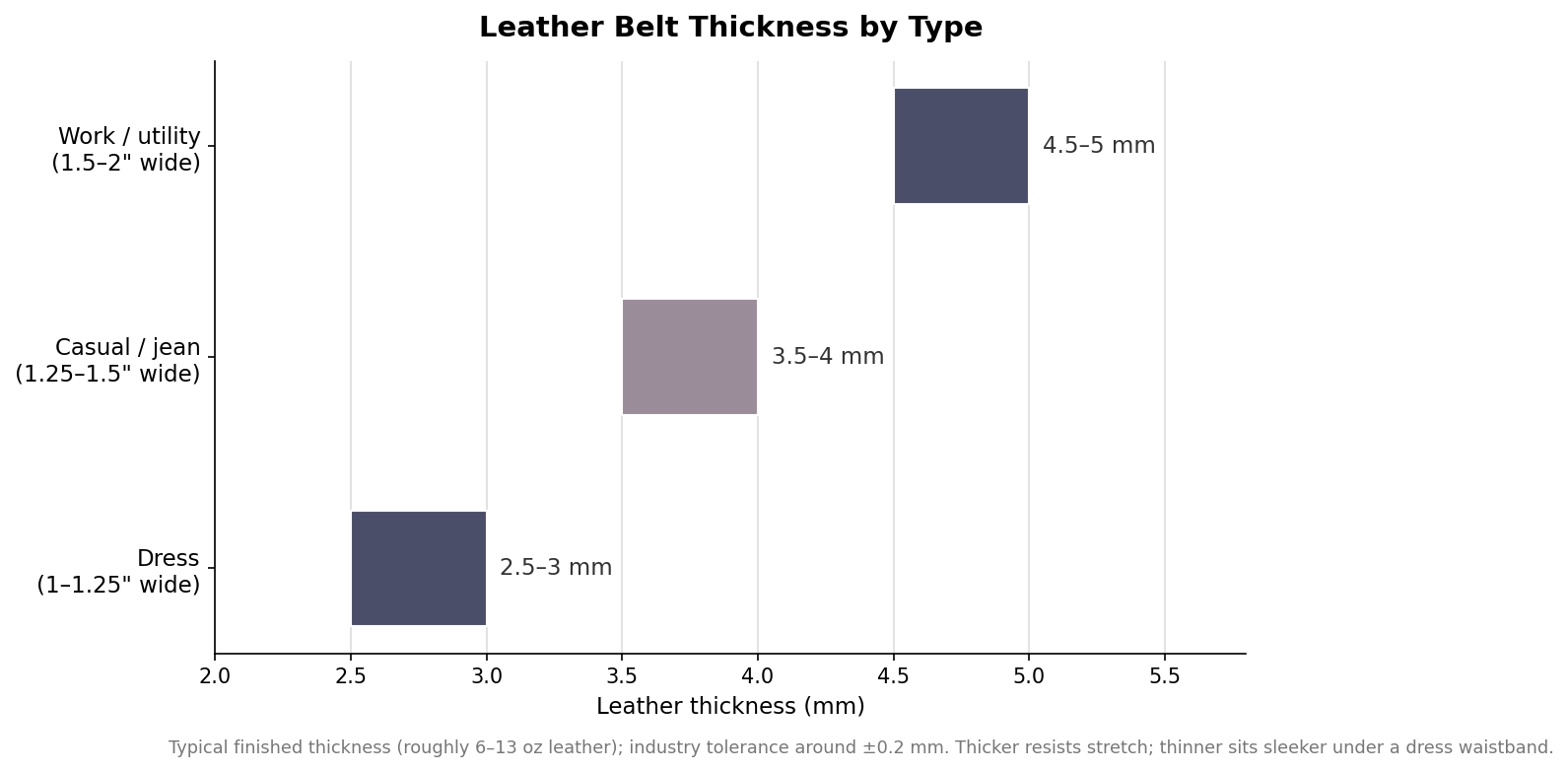
    Thickness follows use. Dress belts run thin and sleek, around 2.5 to 3.0 millimeters, so they sit cleanly under a waistband. Casual and jean belts land near 3.5 to 4.0 millimeters for a sturdier presence, and work or utility belts run 4.5 to 5.0 millimeters to resist stretch under load. In the older ounce system those bands correspond to roughly 6 to 13 ounce leather. Width tracks the same logic: dress belts are about 1 to 1.25 inches, casual belts 1.25 to 1.5 inches, and utility belts 1.5 to 2 inches. A reputable maker holds thickness to a tolerance of around two tenths of a millimeter, so if consistency across a bulk run matters, ask what tolerance they work to.

    Floating bar chart of leather belt thickness in mm by type: dress 2.5-3.0mm, casual 3.5-4.0mm, work/utility 4.5-5.0mm
    Thickness and width should follow the belt’s job, from sleek dress straps to heavy utility belts.

    One useful construction note: a double-ply belt built from two thinner layers bonded together can reach the same finished thickness as a single thick strap while flexing more comfortably and resisting the curl that a solid heavy strip can develop. If you want substance without stiffness, that is worth asking about.

    Buckle style shapes the look and the sizing

    The single-prong pin buckle is the default for dress and most casual belts, simple and easy to size. A double-prong reads heavier and more fashion-forward. Plate or clamp buckles, common on Western and branded belts, attach with snaps so the strap and buckle can be swapped, which is handy when you want one strap to carry interchangeable branded plates. Ratchet or automatic buckles abandon holes entirely and grip a toothed track, giving micro-adjustment in very small increments and a clean hole-free strap, which is why they have become popular in golf and modern dress belts. For casual and promotional programs, a nylon webbing belt with a D-ring or box-frame buckle is inexpensive, endlessly color-matchable, and a natural canvas for a woven or printed logo.

    Getting the size right

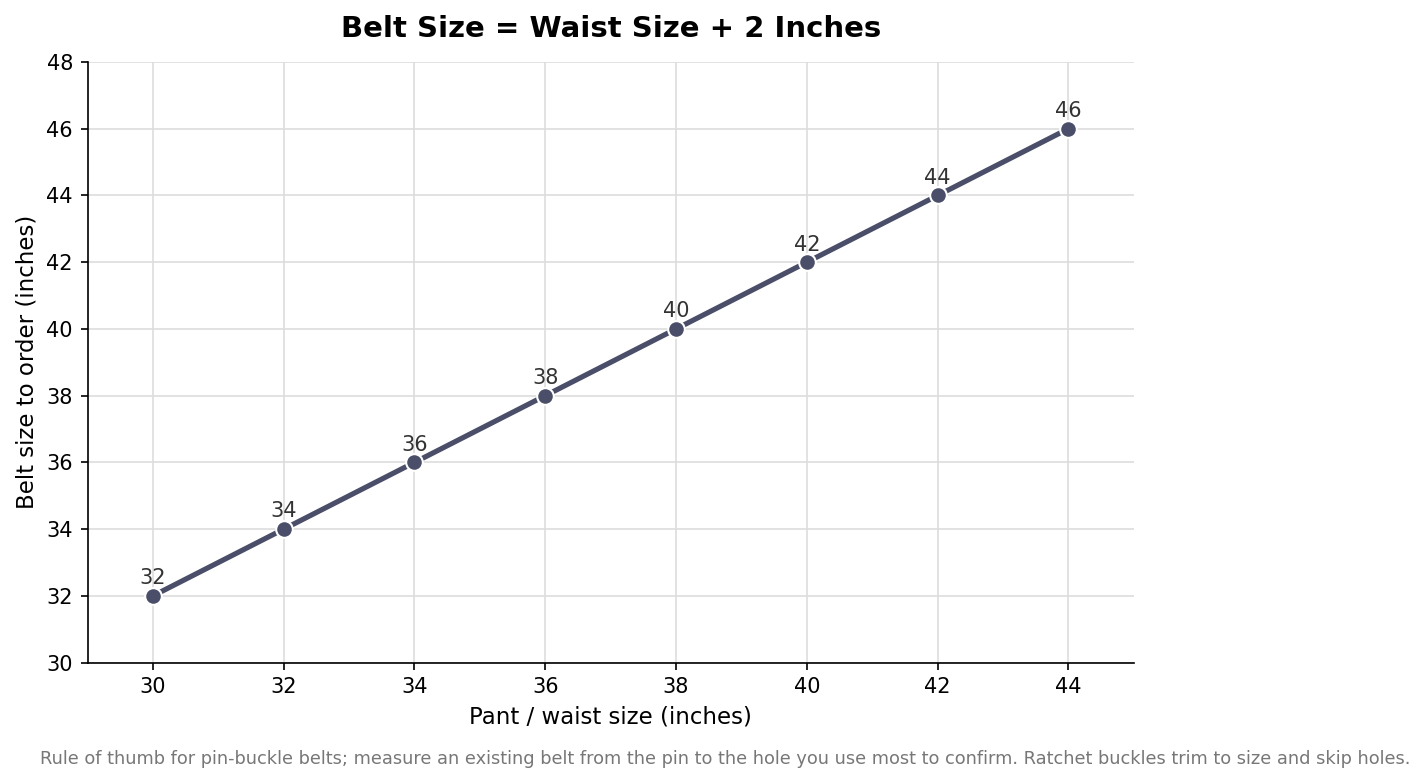
    The reliable rule for pin-buckle belts is to order two inches above the pant waist size, so a 34-inch waist takes a 36 belt. That places the wearer near the middle hole with room on either side. The most accurate method, if a customer already owns a belt that fits, is to measure it from the buckle pin to the hole they actually use, and order that length. Standard belts carry five holes spaced an inch apart, which gives a four-inch total adjustment range, so being off by a size is not fatal but being off by two often is.

    Line chart showing belt size equals waist size plus two inches, from a 30-inch waist to a 44-inch waist
    For pin-buckle belts, ordering two inches above the pant waist size lands the wearer near the middle hole.

    Ratchet and trim-to-fit belts change this math: they typically ship long and are cut down to the wearer, which makes them forgiving for gifting or resale where you do not know exact sizes in advance. If you are running a single bulk size for an unknown group, a trim-to-fit or webbing style removes most of the sizing risk.

    Decoration and how to write the spec

    On leather, the cleanest branding is usually blind embossing or debossing, which presses your mark into the surface without ink, or hot-foil stamping for a metallic finish; laser engraving is another crisp option. On webbing, a woven jacquard logo or a printed repeat runs the length of the strap. Custom buckle plates let the brand live on the metal instead of the leather. Whatever route you choose, bring the full specification to the quote: leather grade, thickness in millimeters, width in inches, buckle type, decoration method, and either the size run or a note that the belts are trim-to-fit. A brief that reads “full-grain, 3.5 mm, 1.5 inch, pin buckle, blind-embossed logo, sizes 32 to 42” produces an accurate price and a predictable belt. “Custom leather belts” invites a bonded-leather substitute that only reveals itself when the strap starts to crack.

  • Hello world!

    Welcome to WordPress. This is your first post. Edit or delete it, then start writing!